Quick answer: Moroccan zellij is more than a colored tile. Historic artisans arrange small cut ceramic pieces into repeating geometric systems: stars, interlacing bands, polygons and rosettes. Today’s designer can borrow the visual language while being precise about what is historically documented and what is simply a contemporary pattern concept. The sections below explain the terms that help architects communicate with a tile specialist.
Research guide · Updated October 2026. Historical sources and supplier suitability are distinguished below; product availability must be verified separately.
Questions answered in this guide
- Why are stars common in traditional Moroccan mosaics?
- What is a zellij rosette?
- What is testir in Moroccan tile geometry?
- What is the difference between star-and-cross and an eight-point star?
- Can geometric zellige be used in modern interiors?
- Are geometric patterns exclusive to Moroccan zellige?
- How should I request a custom mosaic pattern?
Why are stars common in traditional Moroccan mosaics?
Star polygons generate repeatable geometric relationships and can be connected by angular pieces and interlaced bands. Historical examples are not restricted to one star count; composition depends on module proportions and surrounding geometry. A 19th-century panel described by Museum With No Frontiers contains a dominant twelve-pointed star and layered knotwork, while earlier works from Fez show other geometric combinations.
What is a zellij rosette?
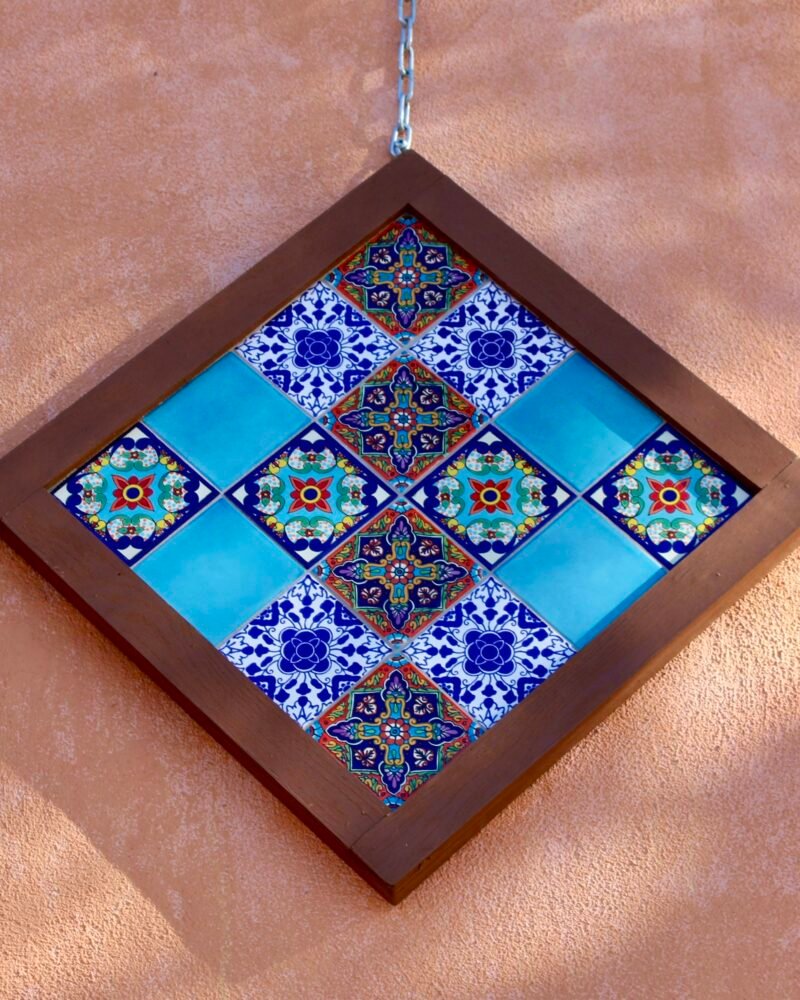
A rosette is a central, often radial motif that organizes surrounding shapes. It may incorporate a star center, repeated petals or polygon modules, depending on the design. ‘Rosette’ is useful in a concept inquiry, but it is not a universal SKU or fixed manufacturing specification. Supply a scaled drawing and installation area to communicate the intended geometry.
What is testir in Moroccan tile geometry?
Museum catalog descriptions use the term ‘testir’ for geometrical patterns used in traditional earthenware tile decoration. These patterns rely on precise relationships and repeatable proportions. The craft requires knowledge of the motif as much as accurate cutting. When restoring an old building, documenting and reproducing the actual underlying pattern is more appropriate than choosing any vaguely similar star.
What is the difference between star-and-cross and an eight-point star?
A star-and-cross field uses alternating units to make a continuous tessellation, while an eight-point star can function as a separate tile or as the center of a complex mosaic. They may require different surrounding filler shapes and assembly methods. A concept rendering does not determine exact cut dimensions or whether a workshop can produce the chosen configuration.
Can geometric zellige be used in modern interiors?
Yes. Architects can use intricate patternwork as a focal point while leaving adjacent walls more restrained, or repeat a limited palette in contemporary spaces. Proportions, grout lines, lighting and surrounding materials influence whether the result feels busy or refined. Request a sample panel or mock-up at the intended scale before finalizing a large order.
Are geometric patterns exclusive to Moroccan zellige?
No. Geometry appears in many world traditions, especially across Islamic architecture. Moroccan zellij has distinctive local craft history and material vocabulary, but star shapes alone do not demonstrate Moroccan origin. Distinguish cultural influence from verified production. Credible museum records and architectural scholarship are better evidence than a generic pattern graphic.
How should I request a custom mosaic pattern?
Send architectural dimensions, preferred motif image, whether the project needs loose tiles or pre-mounted panels, approximate area, color references and destination. Specify the substrate and whether the area is wet, commercial or a floor. The workshop must then confirm feasibility, manufacturing tolerances and samples in writing before the design becomes a production order.
Historical and technical sources
The linked institutional or editorial records support the specific historical or technical points. They do not verify a prospective supplier’s inventory.
Continue your research
Planning a project? Request a project-specific sourcing quote. We verify the workshop and sample after your enquiry; no stock, price or lead time is guaranteed by this article.